Louisiana Becomes French Again During the Napoleonic Era
| Colony of Louisiana Française Louisiane | |||||||||||||||
|---|---|---|---|---|---|---|---|---|---|---|---|---|---|---|---|
| District of New French republic | |||||||||||||||
| 1682–1769 1801–1803 | |||||||||||||||
| The Majestic Banner of France or "Bourbon Flag" was the beginning and nearly normally used flag in New France[i][ii] [3] [4] The bottom coat of arms of France as used by the Government | |||||||||||||||
 New France before the Treaty of Utrecht | |||||||||||||||
| Capital | Mobile (1702–1720) Biloxi (1720–1722) La Nouvelle-Orléans (afterward 1722) | ||||||||||||||
| Population | |||||||||||||||
| • | 1702 – ane,500 Europeans (east and due west of the Mississippi) | ||||||||||||||
| • | 1763 – 20,000 Europeans and Africans (west and due east of the Mississippi) | ||||||||||||||
| • | 1803 – lxx,000 Europeans and Africans (west of the Mississippi) | ||||||||||||||
| • | 1700s – over i million Native Americans (due west and east of the Mississippi) | ||||||||||||||
| • | 1803 – over 0.5 million Native Americans (westward of the Mississippi) | ||||||||||||||
| History | |||||||||||||||
| History | |||||||||||||||
| • Established | 1682 | ||||||||||||||
| • Split up west to Spain | 1762 | ||||||||||||||
| • Divide eastward to Uk | 1763 | ||||||||||||||
| • Transfer by Spain | 21 March 1801 | ||||||||||||||
| • Louisiana Purchase | 30 April 1803 | ||||||||||||||
| • Transferred to the United states | twenty December 1803 | ||||||||||||||
| Political subdivisions | Upper Louisiana; Lower Louisiana | ||||||||||||||
| |||||||||||||||
| Today part of | Canada United States | ||||||||||||||




Louisiana (French: La Louisiane; La Louisiane française) or French Louisiana [5] was an administrative district of New France. Nether French control from 1682 to 1769 and 1801 (nominally) to 1803, the area was named in honor of King Louis Fourteen, by French explorer René-Robert Cavelier, Sieur de la Salle. It originally covered an expansive territory that included virtually of the drainage basin of the Mississippi River and stretched from the Dandy Lakes to the Gulf of Mexico and from the Appalachian Mountains to the Rocky Mountains.
Louisiana included two regions, at present known as Upper Louisiana ( la Haute-Louisiane ), which began due north of the Arkansas River, and Lower Louisiana ( la Basse-Louisiane ). The U.Southward. state of Louisiana is named for the historical region, although it is only a pocket-size part of the vast lands claimed past France.[5]
French exploration of the surface area began during the reign of Louis 14, but French Louisiana was not profoundly developed, due to a lack of homo and fiscal resources. Equally a result of its defeat in the Seven Years' State of war, French republic was forced to cede the east part of the territory in 1763 to the victorious British, and the west office to Spain as compensation for Spain losing Florida. France regained sovereignty of the western territory in the hole-and-corner Third Treaty of San Ildefonso of 1800. Strained past obligations in Europe and the Caribbean, Napoleon Bonaparte sold the territory to the United States in the Louisiana Purchase of 1803, ending France's presence in Louisiana.
The United States ceded part of the Louisiana Purchase to the United Kingdom in the Treaty of 1818. This section lies above the 49th parallel northward in a part of present-twenty-four hour period Alberta and Saskatchewan.
Boundaries, settlement and geography [edit]

The Mississippi River basin and tributaries
In the 18th century, Louisiana included almost of the Mississippi River basin (see drawing alongside) from what is now the Midwestern The states south to the coast of the Gulf of Mexico. Within this vast territory, only two areas saw substantial French settlement: Upper Louisiana (French: Haute-Louisiane), besides known as the Illinois Country (French: Pays des Illinois), which consisted of settlements in what are at present united states of america of Missouri, Illinois, and Indiana; and Lower Louisiana, which comprised parts of the modern states of Louisiana, Arkansas, Mississippi, and Alabama. Both areas were dominated numerically by Native American tribes. At times, fewer than 2 hundred French soldiers were assigned to all of the colony, on both sides of the Mississippi. In the mid-1720s, Louisiana Indians numbered well over 35,000, forming a clear bulk of the colony'due south population."[6]
By and large speaking, the French colony of Louisiana bordered the Great Lakes, particularly Lake Michigan and Lake Erie towards the north; this region was the "Upper Country" of the French province of Canada. To the e was territory disputed with the thirteen British colonies on the Atlantic seaboard; the French merits extended to the Appalachian Mountains. The Rocky Mountains marked the western extent of the French merits, while Louisiana's southern border was the Gulf of United mexican states.
The general flatness of the land aided movement through the territory; its average peak is less than 1,000 metres (iii,300 ft).[ commendation needed ] The topography becomes more mountainous towards the westward, with the notable exception of the Ozark Mountains, which are located in the mid-south.
Lower Louisiana (Basse-Louisiane) [edit]

Lower Louisiana in the white area – the pink represents Canada – office of Canada below the smashing lakes was ceded to Louisiana in 1717. Brownish represents British colonies (map before 1736)
Lower Louisiana consisted of lands in the Lower Mississippi River watershed, including settlements in what are now the U.South. states of Arkansas, Louisiana, Mississippi, and Alabama. The French first explored information technology in the 1660s, and a few trading posts were established in the following years; serious try at settlement began with the institution of Fort Maurepas, well-nigh modern Biloxi, Mississippi, in 1699. A colonial regime before long emerged, with its capital originally at Mobile, afterward at Biloxi and finally at New Orleans (in 1722, four years after the urban center'south founding). The government was led by a governor-general, and Louisiana became an increasingly important colony in the early on 18th century.
The earliest settlers of Upper Louisiana more often than not came from French Canada, while Lower Louisiana was colonized by people from all over the French colonial empire, with various waves coming from Canada, French republic, and the French W Indies.[7]
Upper Louisiana (Haute-Louisiane) [edit]

A new map of the north parts of America claimed by France nether the names of Louisiana in 1720 past Herman Moll
Upper Louisiana, besides known as the Illinois Country, was the French territory in the upper Mississippi River Valley, including settlements and fortifications in what are now u.s.a. of Missouri, Illinois, and Indiana.[viii] French exploration of the area began with the 1673 expedition of Louis Joliet and Jacques Marquette, which charted the upper Mississippi. Every bit noted above, Upper Louisiana was primarily settled by colonists from French Canada.[7] In that location was further substantial intermarriage and integration with the local Illinois peoples.[nine] French settlers were attracted by the availability of abundant farmland also equally by the forests, abundant with animals suitable for hunting and trapping.[10]
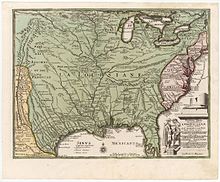
A map of Louisiana past Christoph Weigel, published in 1734
Between 1699 and 1760, half dozen major settlements were established in Upper Louisiana: Cahokia, Kaskaskia, Fort de Chartres, Saint Philippe, and Prairie du Rocher, all on the east side of the Mississippi River in present-twenty-four hour period Illinois; and Ste. Genevieve across the river in today's Missouri.[11] The region was initially governed every bit function of Canada, only was declared to exist part of Louisiana in 1712, with the grant of the Louisiana country to Antoine Crozat.[12] By the 1720s a formal government infrastructure had formed; leaders of the towns reported to the commandant of Fort de Chartres, who in turn reported to the governor-general of Louisiana in New Orleans.[13]
The geographical limits of Upper Louisiana were never precisely defined, just the term gradually came to describe the land southwest of the Corking Lakes. A royal ordinance of 1722 may have featured the broadest definition: all land claimed past France southward of the Great Lakes and northward of the oral cavity of the Ohio River, which would include the Missouri Valley as well as both banks of the Mississippi.[14]
A generation later, trade conflicts between Canada and Louisiana led to a defined boundary betwixt the French colonies; in 1745, Louisiana governor general Vaudreuil ready the northeastern bounds of his domain as the Wabash valley up to the oral fissure of the Vermilion River (near nowadays-day Danville, Illinois); from there, northwest to le Rocher on the Illinois River, and from there westward to the mouth of the Rock River (at nowadays-day Rock Isle, Illinois).[14] Thus, Vincennes and Peoria were the limit of Louisiana's attain. The outposts at Ouiatenon (on the upper Wabash near present-day Lafayette, Indiana), Chicago, Fort Miamis (near nowadays-day Fort Wayne, Indiana), and Prairie du Chien operated as dependencies of Canada.[fourteen]
This boundary remained in effect through the capitulation of French forces in Canada in 1760 until the Treaty of Paris in 1763, later which France surrendered its remaining territory east of the Mississippi to Great U.k.. (Although British forces had occupied the "Canadian" posts in the Illinois and Wabash countries in 1761, they did not occupy Vincennes or the Mississippi River settlements at Cahokia and Kaskaskia until 1764, afterward the peace treaty was ratified.[15]) Every bit part of a full general report on conditions in the newly conquered Province of Canada, Gen. Thomas Gage (and so commandant at Montreal) explained in 1762 that, although the boundary between Louisiana and Canada was not exact, information technology was understood that the upper Mississippi (higher up the rima oris of the Illinois) was in Canadian trading territory.[16]
Following the transfer of power (at which time many of the French settlers on the east bank of the Mississippi crossed the river to what had become Spanish Louisiana) the eastern Illinois Country became office of the British Province of Quebec, and later the United States' Northwest Territory.[17] French colonists who migrated later on they lost control over New French republic founded outposts such as the of import settlement of St. Louis (1764). This became a French fur-trading center, connected to trading posts on the Missouri and Upper Mississippi rivers, leading to later French settlement in that expanse.
In the 1762 Treaty of Fontainebleau, France ceded Louisiana west of the Mississippi River to Spain, its ally in the war, equally compensation for the loss of Castilian Florida to Britain.[18] Even after France had lost its claim to Louisiana, francophone settlement of Upper Louisiana continued for the next 4 decades. French explorers and frontiersmen, such every bit Pedro Vial, were often employed as guides and interpreters by the Spanish and later past the Americans. The Castilian lieutenant governors at St. Louis maintained the traditional "Illinois Country" nomenclature, using titles such as "commander in chief of the western part and districts of Illinois" and administrators unremarkably referred to their capital St. Louis "of the Ylinuses".[14]
In 1800 Spain returned its part of Louisiana to French republic in the Third Treaty of San Ildefonso, merely France sold it to the United states of america in the Louisiana Purchase of 1803.[19] Through this time, but specially following the Louisiana Purchase, French Creoles, equally they chosen themselves, began to move further into the Missouri Ozarks, where they formed mining communities such as Mine à Breton and La Vieille Mine (Old Mines).[xi]
A unique dialect, known as Missouri French, developed in Upper Louisiana. It is distinguished from both Louisiana French and the various forms of Canadian French, such as Acadian. The dialect continued to be spoken around the Midwest, particularly in Missouri, through the 20th century. Information technology is nearly extinct today, with only a few elderly speakers notwithstanding able to use it.[seven]
History [edit]
Exploration of Louisiana [edit]
17th-century explorers [edit]

In 1660, France started a policy of expansion into the interior of N America from what is now eastern Canada. The objectives were to locate a Northwest Passage to People's republic of china; to exploit the territory's natural resource, such equally fur and mineral ores; and to convert the native population to Catholicism. Fur traders began exploring the pays d'en haut (upper country effectually the Great Lakes) at the fourth dimension. In 1659, Pierre-Esprit Radisson and Médard Chouart des Groseilliers reached the western stop of Lake Superior. Priests founded missions, such every bit the Mission of Sault Sainte Marie in 1668. On May 17, 1673, Louis Jolliet and Jacques Marquette began the exploration of the Mississippi River, which they called the Sioux Tongo (the large river) or Michissipi. They reached the oral fissure of the Arkansas River, and and so returned upstream, having learned that the not bad river ran toward the Gulf of Mexico, not toward the Pacific Ocean every bit they had presumed. In 1675, Marquette founded a mission in the Native American village of Kaskaskias on the Illinois River. A permanent settlement was made by 1690.
In 1682, René-Robert Cavelier and the Italian Henri de Tonti descended to the Mississippi River Delta. They left Fort Crèvecoeur on the Illinois River, accompanied by 23 Frenchmen and 18 Indians. They built Fort Prud'homme (afterward the urban center of Memphis) and claimed French sovereignty on the whole of the valley, which they called Louisiane in honor of the French king, Louis Xiv. They sealed alliances with the Quapaw Indians. In April 1682, they arrived at the oral cavity of the Mississippi. Cavelier somewhen returned to Versailles, where he convinced the Minister of the Marine to grant the command of Louisiana to him. He claimed that Louisiana was close to New Espana by cartoon a map showing the Mississippi equally much farther west than it really was.
With four ships and 320 emigrants, Cavelier set sail for Louisiana. Cavelier did not find the river'due south mouth in the Mississippi River Delta and tried to establish a colony on the Texas coast. Cavelier was assassinated in 1687 by members of his exploration party, reportedly near what is at present Navasota, Texas.
Summary chronology [edit]

- 1673: The Frenchmen Louis Jolliet and Jacques Marquette brainstorm to explore the Mississippi River from the north and determine that it must run into the Gulf of Mexico on the south.
- 1675: Marquette founds a mission at the G Village of the Illinois.
- 1680: Fort Crevecoeur founded in the Illinois Land
- 1682: René-Robert Cavelier, Sieur de la Salle, descends the Mississippi to its oral fissure on the Gulf of Mexico.
- 1682: Fort St. Louis du Rocher on the Illinois River is founded
- 1685–88: La Salle attempts to plant a colony on the Gulf of Mexico to secure the unabridged river valley for France. He establishes a camp at Fort Saint Louis; but his mission fails, in function because he fails to rediscover the Mississippi's rima oris.[20]
- 1686: Henri de Tonti establishes Arkansas Mail service, a trading post at the site of a Quapaw Indian hamlet, almost where the Arkansas River meets the Mississippi.
- 1696: Cahokia village in Illinois Country is settled.
- 1699: Pierre Le Moyne, Sieur d'Iberville explores the Louisiana coast and founds Fort Maurepas at Erstwhile Biloxi (at present in Mississippi) on the Gulf of Mexico.
- 1701: Antoine Laumet de La Mothe founds Detroit.
- 1702: In January, Jean-Baptiste Le Moyne, Sieur de Bienville founds Mobile (now in Alabama) as the capital of Louisiana for his blood brother Iberville.[21]
- 1703: Kaskaskia village in Illinois State is settled
- 1713: Étienne de Veniard, Sieur de Bourgmont publishes the starting time study on explorations of the Missouri River.
- 1714: Louis Juchereau de St. Denis founds Natchitoches, the oldest permanent settlement in what is now the Country of Louisiana.
- 1716: Fort Rosalie is established on a bluff overlooking the Mississippi River; the settlement became the town of Natchez.
- 1717: Illinois Country is detached from Canada to be governed past Louisiana (Haute-Louisiane).
- 1718: New Orleans is founded, at a crescent in the river, for protection against flooding.
- 1719: The starting time ships bringing black slaves from Africa arrive at Mobile, Alabama.[21]
- 1720: Biloxi (in the future state of Mississippi) becomes uppercase of French Louisiana.
- 1720: Fort de Chartres is established as the authoritative heart of the Illinois Country.
- 1720: Pawnees destroy the Spanish Villasur expedition near Columbus, Nebraska, effectively catastrophe Spanish incursions into the territory until 1763.
- 1723: New Orleans becomes the official upper-case letter of French Louisiana.
- 1723: Fort Orleans is established near Brunswick, Missouri.
- 1732: Vincennes is established on the Wabash River in the Illinois State (Upper Louisiana).
- 1735: Sainte-Geneviève in the Illinois State (Upper Louisiana) is founded.
- 1755: British regime begin expelling French settlers from the former colony of Acadia (at present Nova Scotia); many migrate to the southernmost parts of Louisiana, where they become the Cajuns.
- 1762: French republic secretly cedes Louisiana to Espana in the Treaty of Fontainebleau (1762).
- 1763: France cedes Canada and Louisiana e of the Mississippi to Great Britain in the Treaty of Paris. The balance of Louisiana, including New Orleans, is formally ceded to Espana and incorporated as Luisiana or Spanish Louisiana into the Castilian Empire.
- 1764: Pierre Laclède founds St. Louis, Missouri.
- 1764: The terms of the Treaty of Fontainebleau are revealed.
- 1768: In the Rebellion of 1768, Creole and German settlers force the new Spanish governor to abscond.
- 1769: Spain quells the rebellion, executes the leaders and officially takes possession, imposing Castilian law.
- 1778: French republic declares war on Great United kingdom, in back up of the American revolution.
- 1779: Spain declares war on Great Britain.
- 1783: The Treaty of Paris officially ends hostilities between the U.S., with its French and Spanish allies, and Great Britain.
- 1788: The Great New Orleans Fire (1788) destroys most of New Orleans, which is later rebuilt in Spanish style.
- 1793: Spain declares war on the French Democracy in the French Revolutionary Wars.
- 1795: France defeats Kingdom of spain in the War of the Pyrenees, ended by the Second Treaty of San Ildefonso.
- 1800: France regains Louisiana in 1803 in the hush-hush Third Treaty of San Ildefonso.
- 1801: The Treaty of Aranjuez stipulated the cession of Louisiana from Kingdom of spain to France to exist a "restoration", not a retrocession.[22] : 50–52 Every bit France had never given any role of Florida to Spain, Kingdom of spain could non give it dorsum.
- 1803: Napoleon Bonaparte sells Louisiana to the The states, a few weeks afterward sending a prefect to New Orleans to assume control.
- 1803: In New Orleans, Spain officially transfers (Lower) Louisiana to French republic in November. Three weeks afterward, in December, France officially cedes it to the United States.
- 1804: In St. Louis in March, Iii Flags Mean solar day, Spain officially transfers Upper Louisiana to France, which then officially cedes it to the Usa.
Political and administrative organization [edit]
It was not like shooting fish in a barrel for an absolute monarchy to administrate Louisiana, a territory several times larger than European France. Louis XIV and his successors tried to impose their absolutist ambitions on the colony, often without giving the colonial administration enough fiscal means to exercise its piece of work.
Absolutism [edit]

If the leaders of Ancien Régime took control of, and sometimes encouraged, the colonization of New French republic, it was for many reasons. The reign of Henry Four gave an important impetus to the colonisation of New France. Henry IV, the first Bourbon king, was personally interested in strange affairs. In the 17th century, the ministers Richelieu and afterward Colbert avant-garde colonial politics. Louis XIV and his ministers were worried virtually the size of the kingdom, over which they constantly competed with other European nations. European rivalry and a game of political alliances greatly marked the history of Louisiana, in straight and indirect ways. Within those shifting conditions, the French desire to limit British influence in Northward America was a constant upshot in royal politics.[ citation needed ]
Louis XIV took intendance to limit the appearance of intermediary bodies and countervailing powers in Due north America. He did not want an associates of notables or parliament. In the 1660s, the colony was regal belongings. In 1685, Louis XIV banned all publishing in New French republic. Between 1712 and 1731, the French possession came under the control of Antoine Crozat, a rich businessman, then under that of the Mississippi Visitor (created by John Police force), which recruited immigrants to settle the colony. In 1731, Louisiana reverted to majestic rule.
In dissimilarity to Metropolitan France, the government applied a unmarried unified law of the land: the Custom of Paris for ceremonious police force (rather egalitarian for the time); the "Code Louis", consisting of the 1667 ordinance on ceremonious procedure[23] and 1670 ordinance on criminal procedure; the 1673 "Code Savary" for trade; and the 1685 Code noir for slavery.[24] This served as an equaliser for a while; riots and revolts against authorization were rare. Just, the centralised authorities had difficulty maintaining communications over the long distance and sailing time that separated France from Louisiana. Toward the end of the 17th century and the starting time of the 18th, the colonists on the Gulf of Mexico were left nigh completely to fend for themselves; they counted far more on the assistance of the Native Americans than on France. The distance had its advantages: the colonists smuggled appurtenances into the colony with dispensation.
Jean-Baptiste Colbert, Louis 14'due south Minister of the Navy and Trade, was eager to stuff the coffers of the Crown. He dissolved the trading companies and took care to increase the production of the country and the colonies. Being a mercantilist, he believed it was necessary to sell as much as possible and to reduce reliance on imports. He imposed a French monopoly on trade. Colbert wanted to reduce the expenditure of the monarchy. It was, however, necessary to invest much money and to mobilize of import human resources retain the American colony. Much work was washed on the economic infrastructure (factories, ports) in metropolitan France, simply the investment was non enough in Louisiana. No programme to facilitate the motion of goods or men was always carried out. The French upkeep was exhausted because of the wars in Europe, just the colonists in Louisiana did not have to pay regal taxes and were free of the hated gabelle.
Colonial assistants [edit]
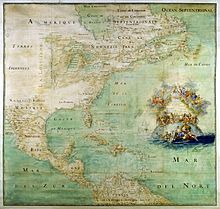
Nether the Ancien Régime, Louisiana formed part of a larger colonial unit of measurement, French American territory—New French republic (Nouvelle France), which included a large office of modern-day Canada. New France was initially ruled by a viceroy in 1625, the Knuckles of Ventadour. The colony was then given a government like the Bourbons' other possessions. Its uppercase was Quebec City until 1759. A governor-general, assisted by a single intendant, was charged with ruling this vast region. In theory, Louisiana was subordinate to Canada, and so it was explored and settled chiefly past French-Canadians rather than colonists from France. Given the enormous altitude between New Orleans and Quebec, communications outside cities and forts were limited.
French settlements were widely dispersed, which afforded them de facto autonomy. The regime decided to break upwards governance of the vast varied colony of New France into 5 smaller provinces, including Louisiana. The Illinois Country, south of the Great Lakes, was added to Louisiana in 1717 and became known as Upper Louisiana. Mobile served every bit French Louisiana's first "capital". The seat of regime moved to Biloxi in 1720, and then to New Orleans in 1722, where the governor lived. While the office of governor general was the near eminent, it was not the most powerful. His was a military machine position that required him to lead the troops and maintain diplomatic relations. The second regional authority was the commissaire-ordonnateur. His was a civil mail with similar functions equally that of the intendants in France: the king's administrator and representative, he oversaw justice, the constabulary, and finances. He managed the upkeep, set prices, presided the Superior Council (Conseil supérieur—the court of justice), and organized the census. Appointed by the rex, Louisiana's commissaire-ordonnateur had wide powers that sometimes conflicted with those of the governor full general. The armed forces outposts of the hinterland were directed by commanders.
Religious establishment [edit]

Saint Louis Cathedral in New Orleans
The French possessions of North America were under the authority of a unmarried Cosmic diocese, whose seat was in Quebec. The archbishop, named and paid by the king, was spiritual head of all New France. With loose religious supervision, the fervor of the population was very weak; Louisianans tended to practice their faith much less than did their counterparts in French republic and Canada. The tithe, a tax by the clergy on the congregations, produced less revenue than in France.
The Church still played an important part in the exploration of French Louisiana; it sent missions, primarily carried out by Jesuits, to catechumen Native Americans. It besides founded schools and hospitals: By 1720, the Ursulines were operating a infirmary in New Orleans. The church and its missionaries established contact with the numerous Amerindian tribes. Certain priests, such as Father Marquette in the 17th century, took part in exploratory missions. The Jesuits translated collections of prayers into numerous Amerindian languages to convert the Native Americans. They also looked for ways to relate Indian practices to Christian worship, and helped show the Natives how these were related. A syncretic religion developed among new Christians. Sincere and permanent conversions were express in number; many who received missionary instruction tended to assimilate the Holy Trinity into their belief of "spirits", or rejected the concept outright.
Colonial society [edit]
It is hard to gauge the total population of France's colonies in North America. While historians have relatively precise sources regarding the colonists and enslaved Africans, estimates of Native American peoples is hard. During the 18th century, the society of Louisiana became quite creolized.
Language [edit]
Colonial French (commonly known as Colonial Louisiana French) is a variety of Louisiana French. It is associated with the misnomer the Cajun French dialect and with Louisiana Creole French, a related creole language. Spoken widely in what is at present the U.S. land of Louisiana, information technology is now considered to have been relabeled as "Cajun French".
Colonial French is conventionally described every bit the form of French spoken in Lower French Louisiana prior to the mass inflow of Acadians afterward the Slap-up Upheaval of the mid-18th century, which resulted in the nascence of the Cajun dialect. The prestige dialect still used by Creoles and Cajuns is often identified as deriving from Colonial French, just some linguists differentiate between the two, referring to the latter as Plantation Society French.
Historically spoken past Louisiana Creole population in lower French Louisiana, Colonial French is generally considered to have been adopted past whites, blacks and Cajuns. Information technology is known among the educated that it has been incorrectly relabelled "Cajun French" by Cajuns and CODOFIL.
Post-obit the Great Upheaval in 1764, when many Acadians were exiled to French Louisiana, Louisiana French was adopted by the Acadians. Some scholars suggested that it survived as the prestige dialect spoken by Creoles, both white and of color, into the 21st century. There are populations of Creoles and Cajuns among other ethnic groups in the parishes of St. Martin, Avoyelles, Iberia, Pointe-Coupée, St. Charles, St. Landry, St. Mary, St. Tammany, Plaquemines, and other parishes south of Orleans, that still speak this prestige dialect.
However, linguists have pointed out this prestige dialect is distinct from the pre-Upheaval Colonial French, and is largely derived from the standard French of the mid-19th century, Castilian, African languages, and Native Americans languages. As such, in 1998 linguist Michael Picone of the University of Alabama introduced the term "Plantation Society French" for the prestige dialect. There is a history of diglossia betwixt Plantation Society French and Louisiana Creole French. Plantation Society French, at any rate, is quite close to the Standard French of the fourth dimension of its origin, with some possible differences in pronunciation and vocabulary utilize.
Information technology is still spoken by the Louisiana Indians, such equally the Houmas, Avoyelles, Choctaw, and other tribal remnants, all present in pre-Acadian Louisiana and still present in contemporary Louisiana.
Native Americans [edit]
According to the demographer Russel Thornton, Due north America contained approximately seven million native inhabitants in 1500. The population plummeted from the 16th century onward, primarily considering of the new infectious diseases carried by Europeans, to which the Native Americans had no caused immunity. At the end of the 17th century, there were likely no more than than 100,000 to 200,000 Native Americans in Lower Louisiana. French colonists forced a small number of Native Americans into slavery, in spite of official prohibition. These slaves were persons who had been captured by rival tribes during raids and in boxing, and sold to French colonists. At the time, many were sent to Saint Domingue in the West Indies for auction as slaves, or to Canada. In Louisiana, planters by and large preferred using African slaves, though some had Native American servants.[ commendation needed ]
Enslaved Africans [edit]

The Lawmaking Noir, which was applied in Louisiana during the 18th century and, later, with some modifications, in the Westward Indies
In 1717, John Law, the French Comptroller Full general of Finances, decided to import African slaves into Louisiana. His objective was to develop the plantation economy of Lower Louisiana. The Regal Indies Company held a monopoly over the slave trade in the expanse. It imported approximately 6,000 slaves from Africa between 1719 and 1743. A small-scale portion of these were sent to the Illinois State to cultivate the fields or to piece of work the lead mines. The economy of Lower Louisiana consequently became slave-dependent. Every bit in other French colonies, the handling of the slaves was regulated by the Code Noir. The slaves often had a degree of autonomy beyond that suggested past the code. Initially, during public holidays, slaves were permitted to sell a portion of the crops they had cultivated. Some would hunt, cut wood or go on livestock far from the plantation. Lastly, although interracial marriages and regroupings of slaves were prohibited, planters often kept slave mistresses. The life and work of the slaves was difficult, with the intense harvest season and processing of sugar undoubtedly the hardest. The maintenance of canals for rice irrigation and travel also involved much labor.
Slave residences and furnishings as supplied by planters were modest. The slaves were given simple straw pallets equally beds. They typically had some trunks and kitchen utensils. The condition of the slaves depended on the treatment they received from their masters. When it was excessively cruel, the slaves frequently fled and hid in the marshes or in New Orleans. The Maroon societies that delinquent slaves founded were often short-lived; Louisiana did not accept the larger and semi-permanent Maroon villages that developed in the West Indies. Meanwhile, slave revolts were not as frequent in this area as they were in the Caribbean. The possibility of being set free was rather low; the slaves could non purchase their liberty. One of the first slaves to exist freed was Louis Congo, who, in 1725, received freedom, country, and bounty in substitution for condign the public executioner of New Orleans.[25] Some freed slaves (notably women and former soldiers) formed small-scale communities, which suffered from segregation; justice was more astringent against them, and they did non have right to possess weapons. Slaves contributed to the creolization of Louisianan club. They brought okra from Africa, a institute mutual in the preparation of gumbo. While the Code Noir required that the slaves receive a Christian education, many secretly practiced animism and frequently combined elements of the two faiths.

Pierre Le Moyne d'Iberville, governor of Louisiana in the early 17th century
Colonists [edit]
Creoles [edit]

French unmarried women transported to Louisiana every bit brides for the colonists
The commonly accepted definition of Louisiana Creole today is the community whose members are a descendant of the "native-built-in" individuals of la Louisiane. Some individuals may non have each indigenous heritage, and some may have additional ancestries. It is estimated that 7,000 European immigrants settled in Louisiana during the 18th century—a hundredth the number of inhabitants of the Thirteen Colonies on the Atlantic coast. Initially, creole was the term used for Europeans (and sometimes, separately for Africans) born in Louisiana, in contrast to those who immigrated there.
Louisiana attracted considerably fewer French colonists than did its West Indian colonies. After the crossing of the Atlantic Ocean, which lasted several months, the colonists had several challenges alee of them. Their living conditions were difficult: uprooted, they had to confront a new, frequently hostile, environment. Many of these immigrants died during the maritime crossing or soon later on their arrival. Concrete conditions were harsh, and the tropical climate was difficult for colonists. Hurricanes, unknown in France, periodically struck the coast, destroying whole villages. The Mississippi River Delta was plagued with periodic floods and yellowish fever epidemics, to which malaria and cholera were added as part of the Eurasian diseases that arrived with the Europeans. These atmospheric condition slowed colonization.
Moreover, French villages and forts were non necessarily safe from enemy offensives. Attacks by Native Americans represented a real threat to the groups of isolated colonists; in 1729, their attacks killed 250 in Lower Louisiana. Forces of the Native American Natchez people took Fort Rosalie (now Natchez, Mississippi) by surprise, killing, amid others, significant women. The French responded with warfare during the next two years: some Natchez were captured and deported as slaves to Saint Domingue; others left the area if they escaped.
Colonists were ofttimes young men, volunteers recruited in French ports or in Paris. Many served as indentured servants; they were required to remain in Louisiana for a length of time stock-still past the contract of service to pay off their passage. During this time, they were "temporary semi-slaves". To increase the colonial population, the crown sent filles à la cassette ("casket girls," referring to the small trunks they arrived with), immature Frenchwomen, to marry the soldiers. They were given a dowry financed by the Male monarch. This practise built upon the 17th-century precedent when Louis 14 paid for transport and dowries for about 800 filles du roi (King'due south Daughters) to immigrate to New France to encourage union and formation of families in the colony.
By contrast, other arrivals were described as women "of easy virtue", vagrants or outlaws, and those without family unit, who arrived in Louisiana with a lettre de cachet; they were sent by force to the colony, especially during the Régence menstruum early in the reign of Louis XV. Their stories inspired the novel Story of the Knight of Grieux and Manon Lescaut, written by Abbé Prévost in 1731. In 1721, the transport La Baleine carried nearly 90 women of childbearing age to Louisiana; they were recruited from the Paris prison of La Salpetrière. Most quickly found husbands among the residents of the colony. These women, many of whom were nigh likely prostitutes or felons, were known as The Baleine Brides.[26]
Communities of Swiss and German peoples also settled in French Louisiana, but imperial government always referred to the population as "French". Later on the 7 Years' War, in which Britain defeated French republic, the settlement attracted a variety of groups: Spanish settlers, refugees from Saint Domingue (particularly after 1791 when the slave uprisings began), opponents of the French Revolution, and Acadians. In 1785, 1633 people of Acadian origin were brought from France to New Orleans, 30 years after having been expelled from Acadia by the British. Other Acadians were transported there by the British after they were expelled from Acadia. Most iv,000 are idea to have settled in Louisiana, gradually forming the Cajun customs.[ citation needed ]
Peasants, artisans, and merchants [edit]
Social mobility was easier in America than in French republic at the time. The seigneurial system was not imposed on the banks of the Mississippi, although the long lot land division scheme of the seigneurial system was adjusted to some of the meandering rivers and bayous there. At that place were few corporations treated hierarchically and strictly regulated.[ clarification needed ] Certain tradesmen managed to build fortunes rather quickly. The big planters of Louisiana were attached to the French way of life: they imported wigs and vesture fashionable in Paris. In the Land of Illinois, the wealthiest constructed rock-built houses and had several slaves. The largest traders generally wound upwards settling in New Orleans.
French soldiers [edit]
The King sent the regular army in the upshot of conflict with the other colonial powers; in 1717, the colony of Mississippi counted 300 soldiers out of 550 people (Havard 1000, Vidal C, History of French America, p. 225.). However, the colonial ground forces, like that of French republic, suffered from desertions. Certain soldiers fled to go coureurs de bois. At that place were few mutinies considering repression was severe. The army held a fundamental identify in the control of the territory. Soldiers built forts and frequently negotiated with the Native Americans.
Coureurs des bois [edit]

The coureurs des bois (literally "runners of the wood") played an important part, though not well documented, in the expansion of French influence in North America. By the finish of the 17th century, these adventurers had journeyed the length of the Mississippi River. They were motivated by the promise of finding golden or of carrying out a assisting fur trade with the Indians. The fur trade, often adept without authorization, was a difficult activity, carried on most of the time by young single men. Many ultimately wished to keep to more sedentary agronomical activities. Meanwhile, a expert number of them were integrated into native communities, learned the languages, and took native wives. A well-known example is the French Canadian Toussaint Charbonneau, married man to Sacagawea, who gave nascence to Jean-Baptiste. They took function in the Lewis and Clark Trek in 1804–1806.
French and the Native Americans [edit]
Ancien Régime France wished to make Native Americans subjects of the male monarch and good Christians, merely the distance from Metropolitan France and the sparseness of French settlement prevented this. In official rhetoric, the Native Americans were regarded as subjects of the male monarch of French republic, simply in reality, they were largely democratic due to their numerical superiority. The local regime (governors, officers) did not have the means of imposing their decisions, and often compromised. The tribes offered essential support for the French in Louisiana: they ensured the survival of the colonists, participated with them in the fur trade, and were used as guides in expeditions. Their alliance was also essential in wars against other tribes and European colonies.[ citation needed ]
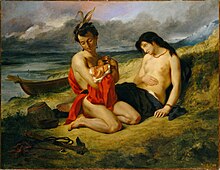
The two peoples influenced each other in many fields: the French learned the languages of the natives, who bought European goods (cloth, alcohol, firearms, etc.), and sometimes adopted their organized religion. The coureurs des bois and the soldiers borrowed canoes and moccasins. Many of them ate native nutrient such as wild rice and diverse meats, like bear and dog. The colonists were oftentimes dependent on the Native Americans for food. Creole cuisine is the heir of these mutual influences: thus, sagamité, for example, is a mix of corn lurid, bear fatty and bacon. Today jambalaya, a discussion of Seminole origin, refers to a multitude of recipes calling for meat and rice, all very spicy. Sometimes shamans succeeded in curing the colonists thanks to traditional remedies (application of fir tree gum on wounds and Purple Fern on a rattlesnake bite).
Many colonists both admired and feared the military power of the Native Americans, only others scorned their civilisation and regarded them as racially less pure than the Whites. In 1735, interracial marriages without the approving of the government were prohibited in Louisiana. The Jesuit priests were often scandalized past the supposedly libertine ways of the Native Americans. In spite of some disagreements (the Indians killed pigs, which devastated corn fields), and sometimes violent confrontations (Fox Wars, Natchez uprisings, and expeditions confronting the Chicachas), the human relationship with the Native Americans was relatively proficient in Louisiana. French imperialism was expressed through some wars and the slavery of some Native Americans. Simply most of the fourth dimension, the relationship was based on dialogue and negotiation.
Economy of French Louisiana [edit]

Profile of an American trapper (Missouri)
Illinois Country [edit]
This comparatively sparsely-settled northern expanse of French Louisiana was formerly the southern role of French Canada, and was transferred in 1717 past gild of the Male monarch. It lies along the Mississippi and its tributaries, and was primarily devoted to grain and cereals agriculture. The French farmers lived in villages (such as almost Fort de Chartres (the colonial administrative centre), Kaskaskia, Prairie du Rocher, and Sainte-Geneviève). They cultivated the land with paid and slave laborers, producing generally corn and wheat. The fields were cleared with ploughs. They raised horses, cows and pigs, and also grew a little tobacco, hemp, flax and grapes (though near wine was still imported from France). Agriculture was seasonal and periodic flooding of the Mississippi took its cost on these communities.
The trading posts in the Illinois State concentrated more often than not on the fur trade. Placed at strategic points, they were modestly fortified. Merely a few were made out of stone (e.k., Fort de Chartres). Similar their American "mountain human" counterparts, the coureurs des bois exchanged beaverskin or deer pelts for weapons, fabric or shoddy goods, because the local economic system was based on barter. The skins and fur are subsequently sold in the forts and cities of New France. The Illinois Country also produced table salt and lead, and provided New Orleans with game.
Lower Louisiana [edit]
Lower Louisiana's plantation economy was based on slave labor. The owners more often than not had their primary residence in New Orleans and entrusted the supervision of the fields to a treasurer.[ citation needed ]
Crops were varied and adjusted to the climate and terrain. Role of the production was intended for utilise by Louisianans (corn, vegetables, rice, livestock), the remainder beingness exported to French republic (especially tobacco and indigo).
Economic role of New Orleans [edit]
New Orleans was the economic majuscule of Louisiana, though information technology remained a village for several decades. The colonists built infrastructure to encourage trade; a canal was dug in 1723.[ citation needed ] The shops on the banks of the Mississippi also served as warehouses. The city exported pelts from the interior also every bit agricultural products from the plantations. It was also, of grade, a local hub of commerce.
The rare shipments from French republic brought food (lard, wheat...), booze, and diverse indispensable finished products (weapons, tools, textile, and clothing). Exports remained relatively weak on the whole. New Orleans continued to sell wood, rice, and corn to the French Due west Indies.
End of French Louisiana [edit]

Seven Years' War and its consequences [edit]
The hostility between the French and British flared up again 2 years before the beginning of the Vii Years' War in Europe. In Northward America, the war became known as the French and Indian War. After some early on victories from 1754 to 1757, thanks to assistance from their Native American allies, the French suffered several disastrous defeats in Canada from 1758 to 1760, culminating in the give up of the upper-case letter city Quebec. With the loss of Canada, defense of Louisiana became impossible.[ citation needed ]
The Treaty of Paris, signed on x February 1763, formalized the eviction of the French from North America. Canada and the due east bank of the Mississippi were handed over to Groovy U.k. (Province of Quebec (1763–91)). New Orleans and the west depository financial institution of the river had been secretly given to Espana the previous year. This decision provoked the difference of a small number of settlers; however, the Spaniards effectively took control of their new territories, which they named Luisiana, rather late (in 1769), and there was not much Spanish clearing. To the East, the U.s.a. foresaw the conquest of the Westward; commercial navigation on the Mississippi was opened to Americans in 1795.[ citation needed ]
Ephemeral renewal of French Louisiana [edit]

The Louisiana Buy territory
During the French Revolution, Louisiana was agitated under Castilian control: certain French-speaking colonists sent petitions to the metropolis and the slaves attempted revolts in 1791 and 1795.
The Third Treaty of San Ildefonso, signed in secrecy on October i, 1800, envisaged the transfer of Western Louisiana likewise as New Orleans to France in exchange for the Duchy of Parma. The transfer was confirmed by the Treaty of Aranjuez signed on March 21, 1801. However, Napoleon Bonaparte soon decided not to keep the immense territory. The army he sent to take possession of the colony was first required to put down a revolution in Saint-Domingue (now Haiti); its failure to practice so, and the rupture of the Treaty of Amiens with the United Kingdom, prompted him to make up one's mind to sell Louisiana to the newly founded Us. This was done on April 30, 1803 for the sum of fourscore million francs (15 one thousand thousand dollars). American sovereignty was established on December twenty, 1803.
French heritage today [edit]

Map of current U.Due south. states that were completely or more often than not inside the borders of post-1764 colonial Louisiana at the time of Louisiana Buy
French colonization in Louisiana left a cultural inheritance that has been celebrated significantly in recent decades. The heritage of the French language, Louisiana Creole French, and Cajun French has been near threatened; for this reason, the CODOFIL (Council for the Evolution of French in Louisiana) was created in 1968. A subject area of debate is the variety of French that should be taught: that of French republic, Canadian French, standard Louisiana French, or Cajun French. Today, many Cajun-dominated areas of Louisiana have formed associations with Acadian communities in Canada, which send French professors to re-teach the linguistic communication in the schools. In 2003, 7% of Louisianans were French-speaking, though most likewise spoke English. An estimated 25% of the state's population has some French beginnings, carrying a number of last names of French origin (e.g., LeBlanc, Cordier, Dauthier, Dion, Menard, Pineaux, Hébert, Ardoin, Roubideaux).
Many cities and villages have names of French origin. They include St. Louis; Detroit; Billy Rouge; New Orleans; Lafayette; Mobile; Des Moines; St. Cloud, Minnesota; and Duluth, Minnesota (All the same, present solar day Duluth is located in what used to be the old Northwest Territory, not the old Louisiana Territory). The flag and the seal of the state of Minnesota carry a French legend. The Iowa state flag uses a variation of the French national flag as its base. Missouri state flag and flag of New Orleans colors are based on French flag. The flag of St. Louis has a fleur-de-lis prominently displayed. Historical festivals and commemorations point out the French presence: in 1999, Louisiana celebrated the 300th anniversary of its foundation; in 2001, Detroit did the same. In 2003, the 200th anniversary of the Louisiana Buy was commemorated on numerous occasions as well as by a formal conference to recollect its history. Sure places testify to a cultural inheritance left by the French; a prime number example is the French Quarter of New Orleans. In 2015, St. Louis celebrated the 250th anniversary of its founding past the French in 1764. Many French forts take been rebuilt and opened to visitors.
A key part of Louisianan civilization finds its roots in the French menstruum: Creole songs influenced the blues and jazz. Cajun music, frequently sung in French, remains very much live today. New Orleans' Carnival season, with its tiptop on Mardi Gras Twenty-four hours, testifies to a long-lived Roman Catholic heritage.
See too [edit]
- French colonization of the Americas
- History of Louisiana
- French Westward Indies
- List of colonial governors of Louisiana
- List of French possessions and colonies
Notes [edit]
- ^ New York Land Historical Association (1915). Proceedings of the New York Land Historical Association with the Quarterly Journal: 2d-21st Annual Meeting with a List of New Members. The Association.
It is most likely that the Bourbon Flag was used during the greater office of the occupancy of the French in the region extending southwest from the St. Lawrence to the Mississippi, known every bit New French republic... The French flag was probably blueish at that time with 3 golden fleur - de - lis ....
- ^ W. Stewart Wallace (1948). The Encyclopedia of Canada, Vol. II, Toronto, University Assembly of Canada. pp. 350–351.
During the French régime in Canada, there does not appear to have been whatever French national flag in the modern sense of the term. The "Banner of French republic", which was equanimous of fleur-de-lys on a blue field, came nearest to being a national flag, since information technology was carried before the king when he marched to battle, and thus in some sense symbolized the kingdom of French republic. During the later on flow of French rule, it would seem that the emblem...was a flag showing the fleur-de-lys on a white basis.... as seen in Florida. There were, however, 68 flags authorized for diverse services past Louis Xiv in 1661; and a number of these were doubtless used in New French republic
- ^ "Fleur-de-lys | The Canadian Encyclopedia". world wide web.thecanadianencyclopedia.ca.
- ^ "INQUINTE.CA | CANADA 150 Years of History The story behind the flag". inquinte.ca.
- ^ a b La Louisiane française 1682-1803, 2002. Although named, " La Louisiane ", that name became the French term for the U.S. state of Louisiana, so, past 1879, the colonial region was chosen La Louisiane française .
- ^ Kathleen DuVall, "Interconnectedness and Diversity in 'French Louisiana'", in Powhatan's Mantle: Indians in the Colonial Southeast, ed. Gregory A. Waselkov, Peter H. Wood, and M. Thomas Hatley, Lincoln, NE: University of Nebraska Press, 2nd edition, 2006, accessed 2015-03-09
- ^ a b c Ammon, Ulrich; International Sociological Association (1989). Condition and Part of Languages and Linguistic communication Varieties. Walter de Gruyter. pp. 306–308. ISBN0-89925-356-3 . Retrieved September 13, 2010.
- ^ Ekberg, Carl J. (2000). French Roots in the Illinois Country. University of Illinois Press. pp. 31–100. ISBN0-252-06924-2 . Retrieved September 9, 2011.
- ^ Ekberg, Carl J. (2002). François Vallé and his Globe: Upper Louisiana Earlier Lewis and Clark . University of Missouri Press. pp. 9–10. ISBN0-8262-1418-five . Retrieved September 14, 2010.
- ^ Ekberg, Carl J. (2002). François Vallé and his World: Upper Louisiana Before Lewis and Clark . University of Missouri Printing. p. v. ISBN0-8262-1418-5 . Retrieved September 14, 2010.
- ^ a b Carrière, J. -M. (1939). "Creole Dialect of Missouri". American Speech. Duke Academy Printing. 14 (2): 109–119. doi:ten.2307/451217. JSTOR 451217.
- ^ Gross, William (1881). The History of Municipal Constabulary in Illinois. Springfield: Illinois Country Bar Association. p. 66. Retrieved 28 November 2014.
- ^ Ekberg, Carl J. (2002). François Vallé and his World: Upper Louisiana Before Lewis and Clark . Academy of Missouri Press. p. x. ISBN0-8262-1418-5 . Retrieved September 14, 2010.
- ^ a b c d Ekberg, Carl (2000). French Roots in the Illinois Country: The Mississippi Frontier in Colonial Times. Urbana and Chicago: University of Illinois Printing. pp. 32–33. ISBN978-0252069246 . Retrieved 29 November 2014.
- ^ Hamelle, W. H. (1915). A Standard History of White Canton, Indiana. Chicago and New York: Lewis Publishing Co. p. 12. Retrieved 29 Nov 2014.
- ^ Shortt, Adam; Doughty, Arthur M., eds. (1907). Documents Relating to the Ramble History of Canada, 1759–1791. Ottawa: Public Archives Canada. p. 72. Retrieved 29 Nov 2014.
- ^ Carrière, J. -K. (1941). "The Phonology of Missouri French: A Historical Written report". The French Review. 14 (five): 410–415. JSTOR 380369.
- ^ Gannon, Michael (1996). The New History of Florida, p. 134. University Press of Florida. ISBN 0-8130-1415-viii.
- ^ John Wright (xxx November 2001). The New York Times Almanac 2002. Psychology Press. p. 223. ISBN978-1-57958-348-four.
- ^ Dupré, Céline (1979) [1966]. "Cavelier Sieur de La Salle, René Robert". In Brown, George Williams (ed.). Dictionary of Canadian Biography. Vol. I (1000–1700) (online ed.). Academy of Toronto Printing.
- ^ a b "Alabama Exploration and Settlement" (history), Encyclopædia Britannica Online, 2007, Britannica.com webpage: EB-Mobile. Archived July xi, 2006, at the Wayback Machine
- ^ Chambers, Henry E. (May 1898). West Florida and its relation to the historical cartography of the United states of america. Baltimore, Maryland: The Johns Hopkins Press.
- ^ Official title: Ordonnance civile cascade la réformation de la justice, but now referred to equally Ordonnance de Saint Germain en Laye.
- ^ Jean Louis Bergel, "Principal Features and Methods of Codified", Louisiana Law Review 48/5 (1988): 1074.
- ^ Dawdy, Shannon Lee. "The Burden of Louis Congo and the Development of Savagery in Colonial Louisiana". Discipline and the other body: correction, corporeality, colonialism. Edited by Steven Pierce & Anupama Rao. Duke University Press, 2006. pp 61–89.
- ^ "The Baleine Brides: A Missing Send's Scroll for Louisiana", National Genealogical Guild Quarterly, December 1987; vol. 75, number 4
References [edit]
French [edit]
- Arnaud Balvay, 50'Epée et la Plume. Amérindiens et Soldats des Troupes de la Marine en Louisiane et au Pays d'en Haut, Québec, Presses de l'Université Laval, 2006. ISBN 978-2-7637-8390-1
- Arnaud Balvay, La Révolte des Natchez, Paris, Editions du Félin, 2008. ISBN 978-2-86645-684-9
- Michaël Garnier, Bonaparte et la Louisiane, Kronos/SPM, Paris, 1992, 247 p. ISBN 2-901952-04-6.
- Marcel Giraud, Histoire de la Louisiane française (1698–1723), Presses Universitaires de France, Paris, 1953–1974, iv tomes.
- Réginald Hamel, La Louisiane créole politique, littéraire et sociale (1762–1900), Leméac, coll. « Francophonie vivante », Ottawa, 1984, 2 tomes ISBN two-7609-3914-half dozen.
- Gilles Havard, Cécile Vidal, Histoire de 50'Amérique française, Flammarion, coll. « Champs », Paris, second ed. (1st ed. 2003), 2006, 863 p. ISBN 2-08-080121-X.
- Philippe Jacquin, Les Indiens blancs: Français et Indiens en Amérique du Nord (XVIeast – XVIIIdue east siècles), Payot, coll. « Bibliothèque historique », Paris, 1987, 310 p. ISBN 2-228-14230-1.
- Gilles-Antoine Langlois, Des villes pour la Louisiane française: Théorie et pratique de l'urbanistique coloniale au XVIIIe siècle, L'Harmattan, coll. « Villes et entreprises », Paris, 2003, 448 p. ISBN ii-7475-4726-four.
- Thierry Lefrançois (dir.), La Traite de la Fourrure: Les Français et la découverte de l'Amérique du Nord, Musée du Nouveau Monde, La Rochelle et 50'Albaron, Thonon-les-Bains, 1992, 172 p. ISBN 2-908528-36-iii; Catalogue de 50'exposition, La Rochelle, Musée du Nouveau-Monde, 1992
- Bernard Lugan, Histoire de la Louisiane française (1682–1804), Perrin, Paris, 1994, 273 p. ISBN ii-7028-2462-5, ISBN 2-262-00094-8.
- Jean Meyer, Jean Tarrade, Annie Rey-Goldzeiguer, Histoire de la France coloniale, t. 1, A. Colin, coll. « Histoires Colin », Paris, 1991, 846 p. ISBN 2-200-37218-3.
English [edit]
- Charles J. Balesi, The Time of the French in the Center of North America (1673–1818), Alliance française de Chicago, Chicago, 2nd ed. (1st ed. 1992), 1996, 348 p. ISBN i-88137-000-iii.
- Glenn R. Conrad (dir.), The French Experience in Louisiana, University of Southwestern Louisiana Press, La Fayette, 1995, VIII–666 p. ISBN 0-940984-97-0.
- Marcel Giraud, A History of French Louisiana (1723–1731), tome 5, Louisiana State Academy Press, Baton Rouge, 1991.
- Charles R. Goins, J. Chiliad. Calwell, Historical Atlas of Louisiana, Norman, OK: University of Oklahoma Press, 1995.
- V. Hubert, A Pictorial History, Louisiana, Ch. Scribner, New York Metropolis, 1975.
- Robert Due west. Neuman, An Introduction of Louisiana Archæology, Louisiana State University Press, Baton Rouge/ Londres, 1984, XVI–366 p. ISBN 0-8071-1147-iii.
- Russel Thornton, American Indian Holocaust and Survival..., Norman, University of Oklahoma Press, 1987.
- Sophie White, Wild Frenchmen and Frenchified Indians: Material Culture and Race in Colonial Louisiana. Philadelphia: Academy of Pennsylvania Press, 2012.
External links [edit]
- (in French) Site du ministère de la culture française: La Louisiane française (1682–1803)
- (in French) Bibliothèque Nationale de France: La France en Amérique
- (in French) Archives Canada-France: Nouvelle-French republic. Histoire d'une terre française en Amérique
- (in French) Site personnel de Jean-Pierre Pazzoni: Histoire de la Louisiane française
- (in French) Site de l'association French republic-Louisiane: Louisiane française. Entretien avec Bernard Lugan
- (in French) Hérodote: nine avril 1682, Cavelier de la Salle baptise la Louisiane
- (in French) Academy of Laval: 30 avril 1803: traité d'achat de la Louisiane
- Museum of the Country of Louisiana
- Fort Rosalie, Mississippi
- New France: 1524–1763
- History of New Orleans
Source: https://en.wikipedia.org/wiki/Louisiana_(New_France)#:~:text=1800%3A%20France%20regains%20Louisiana%20in,could%20not%20give%20it%20back.
0 Response to "Louisiana Becomes French Again During the Napoleonic Era"
Post a Comment